How to Build a Layered Cybersecurity Strategy for Networks, Endpoints, and Cloud Environments
| Ask This | A Good Answer Sounds Like | A Warning Sign Sounds Like |
|---|---|---|
| What will you look at first? | Traffic, access rules, backups and license state | A product demo before any questions |
| What do we already own that works? | A list of what stays and why | Everything needs replacing |
| Who watches this out of hours? | Named coverage hours and a response commitment | The dashboard will alert you |
| How will we know it worked? | A monthly report of what patched and what was blocked | You will feel more secure |
| Can we take the plan elsewhere? | Yes, the assessment is yours | The plan only works with our contract |
| Who does the work on site? | Named local engineers who can attend | Everything is handled remotely, always |
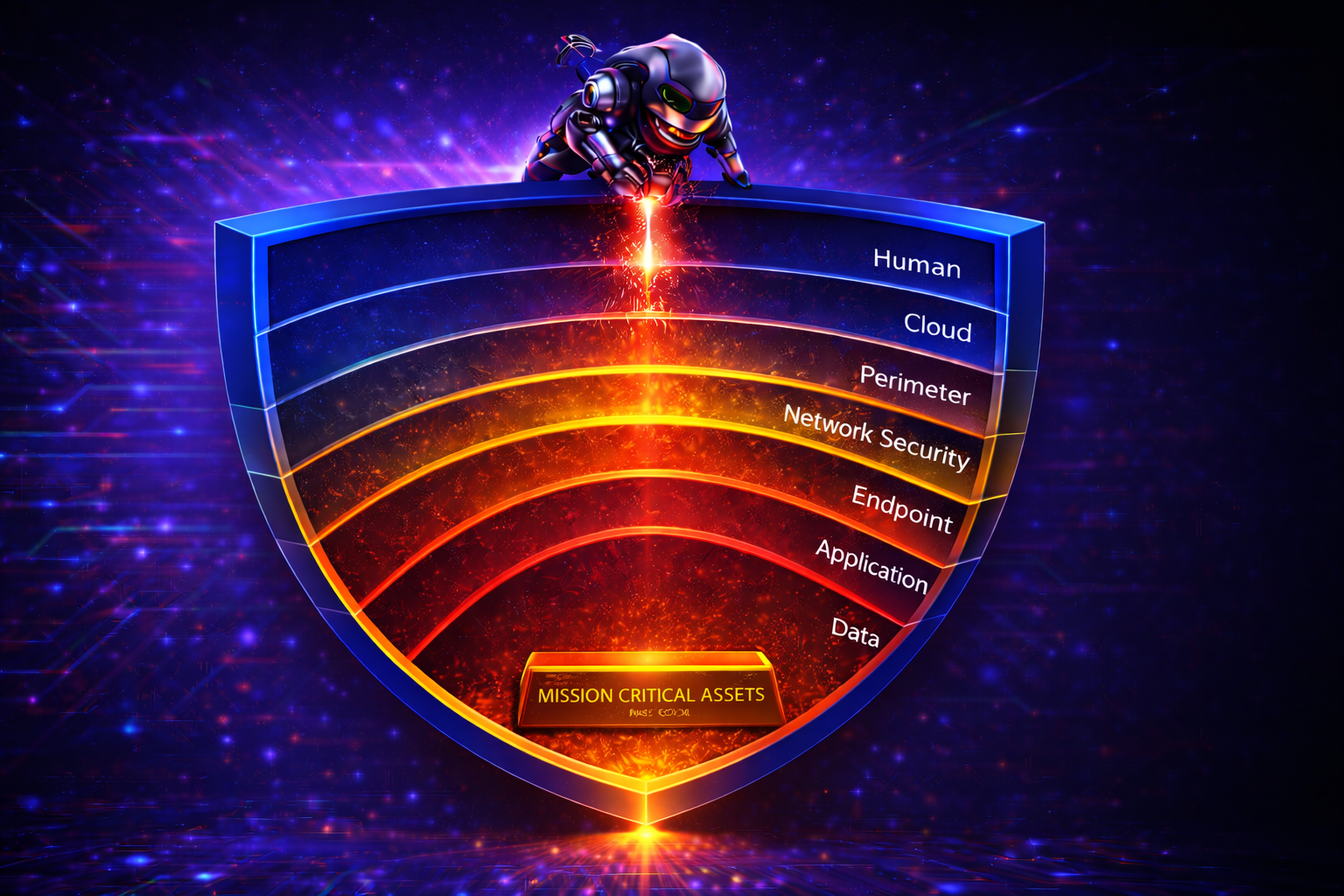
A layered cybersecurity strategy protects an organization by placing multiple security controls across networks, endpoints, cloud systems, identities, applications, and data. If one control fails, another can detect, block, or contain the threat. The strongest approach combines prevention with continuous monitoring, access controls, incident response, and recovery rather than relying on a single firewall or antivirus product.
Modern businesses rarely operate from one secure perimeter. Employees work remotely, applications run in the cloud, endpoints connect from different locations, and sensitive data moves between systems.
What Is a Layered Cybersecurity Strategy?
A layered cybersecurity strategy uses several security controls that work together to reduce the chance that one mistake, compromised account, or failed tool becomes a major incident. Each layer has a different job, such as blocking malicious traffic, protecting devices, controlling access, detecting unusual behavior, or helping the business recover.
This approach is often called defense in depth. The goal is not to create an impenetrable system. No single security product can guarantee that. The goal is to make attacks harder to execute, easier to detect, and less damaging when something gets through.
A practical strategy should cover at least these areas:
- Network security
- Endpoint protection
- Security monitoring and response
- Cloud and application security
- Secure Remote Access (ZTNA)
- Disaster Recovery Planning
- Data protection and recovery
The layers should also share information. A suspicious endpoint event becomes more useful when a security team can compare it with firewall activity, cloud logins, identity events, and other signals.
How Does Network Security Form the First Major Layer?
Network security controls traffic between systems and helps prevent unauthorized connections from reaching sensitive resources. A properly configured firewall should enforce business rules, inspect traffic, restrict unnecessary access, and provide useful security logs rather than simply block obvious threats.
Firewalls are most effective when paired with thoughtful network design. Separate critical systems from general user traffic where practical, restrict administrative interfaces, and avoid allowing broad access just because a device is connected to the internal network.
Network segmentation is especially useful for limiting lateral movement. If an attacker compromises one workstation, segmentation can make it harder to reach servers, backup systems, or sensitive applications.
Access points and switches also deserve attention. Unmanaged devices, outdated firmware, weak administrative passwords, and unnecessary network services can create openings that a perimeter firewall cannot solve.
A useful rule is simple: allow only the traffic that a system actually needs.
Network controls should also generate logs that can be reviewed centrally.
Why Is Network Segmentation Important?
Network segmentation limits how far an attacker can move after gaining access to one system. Instead of treating the entire network as one trusted space, organizations can separate users, servers, guest devices, administrative systems, and other sensitive resources according to their needs.
Segmentation should not be treated as a replacement for endpoint or identity security. A stolen account may still provide legitimate access across several segments. Use segmentation as one barrier within a larger security plan.
How Should Endpoints Be Protected?
Endpoint protection should combine malware prevention, behavioral detection, device visibility, patch management, application controls, and response capabilities. Laptops and desktops are frequent entry points because they interact directly with users, email, websites, files, and external devices.
Traditional antivirus remains useful, but modern endpoint security should also look for suspicious behavior. Examples include unusual PowerShell activity, unauthorized credential access, ransomware-like file changes, unexpected persistence mechanisms, or processes behaving differently from normal patterns.
Tools such as SentinelOne, CrowdStrike Falcon, and Capture Client can form part of an endpoint protection strategy, depending on the organization's requirements and technology environment. Having oversight and management of these endpoints is just as critical.
To overlook unmanaged endpoints will also create a risk. A security platform may protect corporate devices while missing personal laptops, temporary systems, contractor equipment, or devices that have fallen out of management.
Endpoint security also needs a response plan. If a device shows signs of compromise, the security team should know who can isolate it, investigate the event, preserve relevant evidence, reset credentials, and restore normal access.
How Can Identity Controls Strengthen Every Security Layer?
Identity controls connect security decisions to the person, device, application, and resource requesting access. Strong identity security should include multi-factor authentication, least-privilege access, privileged account controls, timely removal of inactive accounts, and regular access reviews.
One common mistake is protecting the network while giving users excessive permissions. If an attacker steals a highly privileged account, strong network defenses may not prevent serious damage.
Use separate administrative accounts for privileged tasks rather than giving everyday accounts administrator rights. Review service accounts as well. Old service accounts with permanent privileges can become overlooked paths into important systems.
Zero trust provides a useful model here. NIST describes zero trust as an approach that does not grant implicit trust based only on network location or ownership; authentication and authorization are evaluated before access to resources.
This matters in hybrid environments because an employee accessing a cloud application from outside the office should still face appropriate identity and device checks.
What is your strategy when there is a Disaster?
A well-designed disaster recovery (DR) plan helps minimize downtime, protect critical data, and keep essential operations running during a cyber incident. By defining recovery procedures before an attack occurs, your team can respond quickly instead of making critical decisions and possible missteps in the middle of a crisis. Regularly testing and updating your DR plan ensures you are prepared to restore operations when every minute counts.
How Do Monitoring and SIEM Complete the Strategy?
Monitoring turns individual security events into useful information about what is happening across the environment. A Security Operations Center (SOC) and SIEM can collect and analyze signals from endpoints, firewalls, servers, applications, identities, and cloud services.
Without monitoring, an organization may have strong security tools but little awareness when something unusual happens.
A good monitoring program should focus on meaningful events rather than generating an overwhelming number of alerts. Examples include repeated failed logins, privilege changes, suspicious endpoint behavior, unexpected administrative activity, unusual data transfers, and attempts to access restricted systems.
Managed detection and response (MDR) can add another layer when an internal team does not have the staff or expertise to investigate alerts around the clock.
The goal is not simply to collect logs. The team must know what deserves attention and what action should follow.
What Happens When a Security Control Fails?
A layered strategy must assume that some controls will fail. An employee may click a malicious link, credentials may be stolen, a vulnerability may remain unpatched, or a cloud account may be misconfigured.
This is where response and recovery become separate security layers.
Create an incident response plan that defines who investigates, who can isolate systems, who communicates with leadership, and who makes decisions about restoring services. Test the plan rather than leaving it as an unused document.
Backups are equally important. Keep backups protected from ordinary administrative access, monitor them for failures, and test restoration. A backup that has never been restored successfully should not be treated as a proven recovery resource.

What Are Common Layered Security Mistakes?
The most common mistake is buying more security tools without creating a security plan. Multiple products do not automatically create multiple effective layers.
Another problem is poor integration. If endpoint alerts never reach the people monitoring network and identity events, important connections can be missed.
Organizations also sometimes focus heavily on prevention and neglect recovery. A mature strategy asks what happens after an attacker bypasses the first control.
Other mistakes include:
- Leaving unused accounts active
- Giving users more access than they need
- Ignoring cloud configurations
- Failing to patch internet-facing systems
- Not monitoring firewall and endpoint logs
- Treating backups as automatically reliable
- Allowing security alerts to go unreviewed
- Forgetting third-party access
Regular reviews help ensure the layers remain aligned as employees, applications, devices, and business processes change. Each of these layers adds to the complexity of the risk.
People Also Ask
What Is The Main Goal Of Layered Cybersecurity?
The main goal is to prevent one security failure from becoming a major incident. Multiple controls can block threats, detect suspicious activity, limit attacker movement, and support recovery when prevention fails.
Is A Firewall Enough To Protect A Business Network?
No. A firewall protects network traffic but cannot fully address compromised endpoints, emails, stolen credentials, malicious cloud activity, insider misuse, or every application-level threat. Firewalls should be complemented and work alongside endpoint, identity, cloud, monitoring, and recovery controls.
What Is The Difference Between Endpoint Security And Network Security?
Network security protects connections and traffic between systems, while endpoint security protects individual devices such as laptops, desktops, and servers. Both are needed because an attacker can enter through either a network pathway or a compromised device.
Does Zero Trust Replace A Firewall?
No. Zero trust and firewalls address different parts of security. Zero trust focuses on verifying users, devices, and resource access rather than trusting a connection because it comes from an internal network. Firewalls focus on controlling and inspecting the traffic moving into, out of, and across the network—blocking malicious traffic, enforcing security policies, and detecting threats.
In simple terms: Zero Trust verifies the access; the firewall protects the traffic.
How Often Should A Cybersecurity Strategy Be Reviewed?
Review the strategy at least annually and after major changes such as cloud migrations, new applications, acquisitions, significant workforce changes, or security incidents. High-risk controls such as privileged accounts, exposed systems, and backups should be reviewed more frequently.
Conclusion
A strong layered cybersecurity strategy is a blend that connects all these elements: network security, endpoint protection, identity controls, cloud security, monitoring, incident response, and recovery. The goal is to create multiple opportunities to prevent, detect, contain, and recover from an attack instead of depending on only one security facet or product.
PCs2U, Inc. helps organizations build layered cybersecurity defenses across networks, endpoints, cloud environments, and infrastructure using technologies such as SonicWall, SentinelOne, CrowdStrike Falcon, SOC/SIEM, MDR, and zero trust solutions.
Contact us to assess your current defenses and build a cybersecurity strategy designed around your organization's risks.
Recent Posts